-
前列腺癌是严重威胁男性健康的泌尿系统恶性肿瘤之一[1]。2021年,美国估计有7万多例新发病例,1万多例因前列腺癌死亡[2]。我国前列腺癌发病率也逐年上升,且趋于年轻化[3]。前列腺癌治疗后5年复发率较高[4],复发后往往伴有临床进展。前列腺癌是一种异质性疾病,在病理相似的患者中临床表现差异大[5-6]。研究发现肿瘤抑制基因沉默在前列腺癌的发生进展中起重要作用[7]。肿瘤抑制基因甲基化是表观遗传改变的主要方式之一[8-9]。脆性组氨酸三联体基因(fragile histidine triad,FHIT)是表观遗传容易改变的肿瘤抑制基因,前列腺癌中多种基因甲基化与前列腺癌临床病理有关,但血清FHIT甲基化状态与前列腺癌患者临床病理及预后的关系尚少见报道。本研究采用甲基化特异性PCR法(Methylation-specific PCR,MSP)检测前列腺癌血清中FHIT甲基化状态,探讨FHIT甲基化状态与前列腺癌患者5年生化复发及临床进展之间的关系。
-
1 资料与方法
-
1.1 一般资料
-
选取浙江大学医学院附属金华医院(金华市中心医院)泌尿外科2015年1月—2017年6月标本库中用液氮保存的前列腺癌患者血液78例(临床病理确诊为前列腺癌)和同期前列腺增生患者血液标本45例。前列腺癌患者年龄61.2~80.4岁,平均年龄68.5岁。分化程度按Gleason分级评价,≤7分者49例,8~10分者29例。按TNM分期:Ⅰ~Ⅱ期48例,Ⅲ~Ⅳ期30例。所有病例均未采用放疗、化疗、内分泌和免疫治疗。纳入标准:1)前列腺癌诊断明确,无其他部位肿瘤;2)未伴有膀胱其他病理类型肿瘤;3)有完整随访资料。前列腺增生患者年龄62.0~80.6岁,平均年龄69.2岁,两组体重指数、前列腺体积及IPSS评分等一般资料比较无统计学差异。本研究经本院伦理委员会审核通过,与患者签署知情同意书。
-
1.2 标本选取
-
自标本库中提取两组患者血液标本。所有患者留取血液标本在实验前经组织病理和血液标本核对无误后进行实验。
-
1.3 DNA提取与MSP
-
使用Dne-asy Tissue Kit(700562,德国Qiagen公司)购自武汉博士德公司。按照说明书提取组织DNA;采用EZDNA Methylation-Gold TMKit(F6002,美国Zymo Research公司)试剂盒产品,按照试剂盒说明行DNA亚硫酸氢钠修饰并纯化,分别应用甲基化和非甲基化引物进行PCR。甲基化引物:5’-TTGGGGCGCGGGTTTGGGTTTTTACGC-3’,5'-CGTAAACGACGCCGACCCCACTA-3’;FHIT非甲基亿引物:5'-TTGGGGTGTGGGTTTGGGTTTTTATG-3’,5'-CATAAACAACACCAACCCCACTA-3’,74 bp。反应条件:95℃预变性5 min;35个循环的扩增反应,反应程序为95℃变性 30 s,60℃退火30 s,72℃延伸 30 s;最后4℃保温。反应结束后取PCR产物,用2%琼脂糖凝胶电泳,最后凝胶成像系统照相,判定结果以是否出现条带表示,甲基化引物扩增条带或同时出现扩增产物条带判断为DNA甲基化阳性;非甲基化引物扩增出条带判断为DNA甲基化阴性。
-
1.4 统计学处理
-
采用SPSS 26.0统计软件进行资料分析,计数资料用率表示,比较采用χ2检验或Fisher确切概率法;采用Kaplan-Meier生存分析法比较患者5年生化复发和5年临床进展情况,以P<0.05为差异有统计学意义。
-
2 结果
-
2.1 前列腺癌与前列腺增生患者血清中FHIT基因甲基化阳性率比较
-
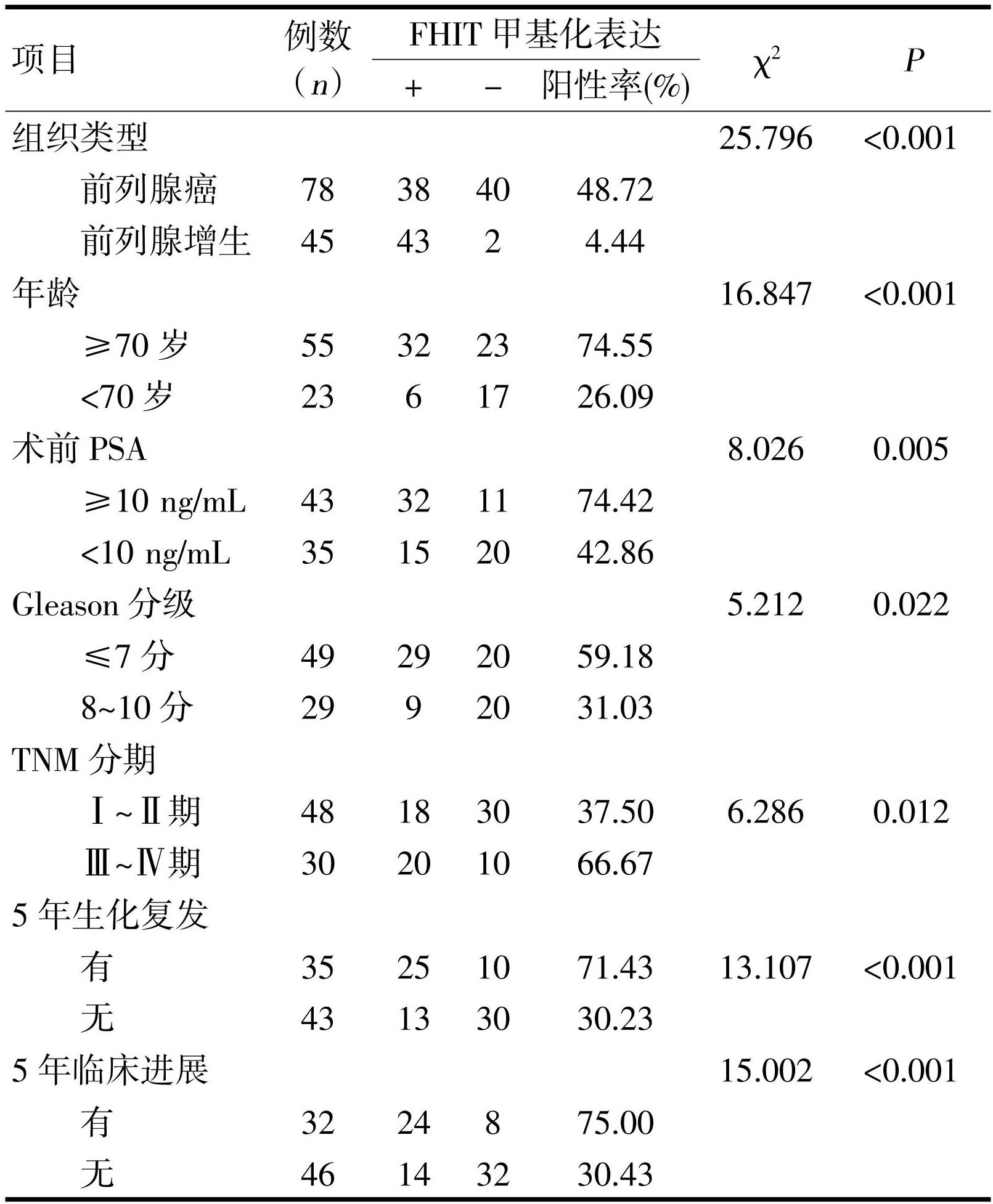
前列腺癌患者FHIT甲基化率为48.72%(38/78),明显高于增生前列腺患者的4.44%(2/45),差异有统计学意义(P<0.05)。见图1。
-
图1 前列腺癌中FHIT甲基化状态的电泳图
-
2.2 FHIT甲基化与前列腺癌患者临床特征的关系
-
前列腺癌中FHIT甲基化与患者年龄、术前PSA、Gleason分级、TNM分期、5年生化复发和5年进展有关,差异均有统计学意义(P<0.05)。FHIT甲基化率在Gleason分级≤7分的阳性表达率为59.18%,高于8~10分表达阳性率31.03%;Ⅰ~Ⅱ期阳性表达率为37.50%;低于Ⅲ~Ⅳ期阳性表达率66.67%。见表1。
-
2.3 FHIT甲基化与前列腺癌患者5年累计生化复发率和5年累计进展率的关系
-
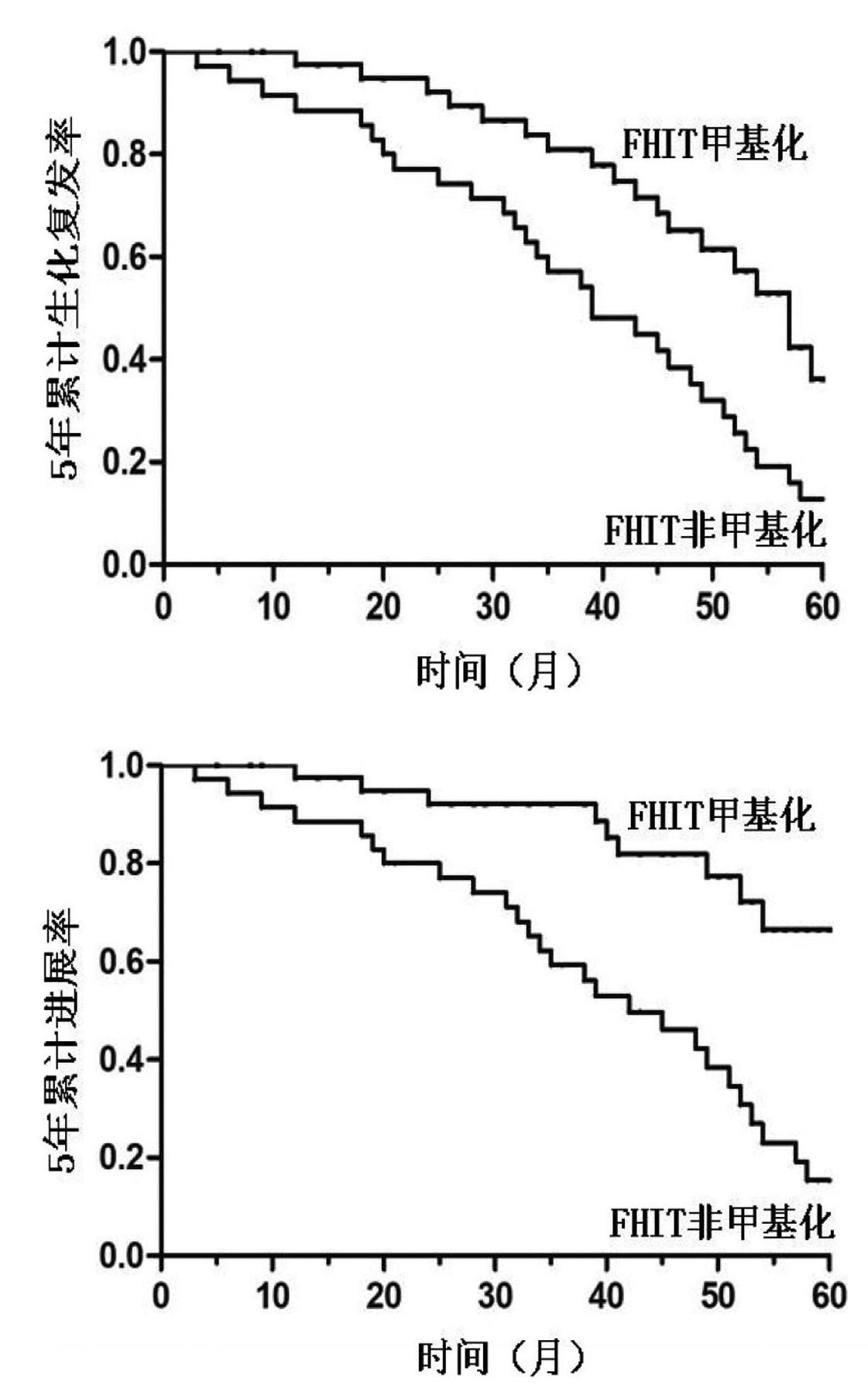
78 例前列腺癌患者中,甲基化组5年复发率为71.43%(25/35),明显高于非甲基化组的30.23%(13/43),差异有统计学意义(P<0.05);甲基化组5年累计临床进展率为75.00%(24/32),高于非甲基化组的30.43%(14/46),差异有统计学意义(P<0.05)。见图2。
-
图2 FHIT甲基化与前列腺癌患者累计5年生化复发及累计5年临床进展的关系
-
3 讨论
-
越来越多的证据表明,肿瘤抑制基因甲基化促进肿瘤的发生和进展[10-11]。FHIT基因是典型的肿瘤抑制基因,跨域人类染色体脆性位点,是表观遗传学上容易发现突变的部位。野生型FHIT基因通过多种作用方式抑制肿瘤生长和转移[12],但FHIT基因甲基化状态与前列腺癌患者的临床病理及预后仍不清楚。
-
前列腺癌是与遗传相关的疾病,表观遗传在前列腺癌发病中有重要作用[13]。甲基化是抑癌基因表观遗传改变的一种方式;FHIT甲基化失活促进了肿瘤细胞的侵袭和转移[14];最近的一项单核苷酸多态性rs760317(其中包含了FHIT基因)与前列腺癌临床相关性研究,对来自323个高加索家庭的817例患有前列腺癌(n=434)和未患前列腺癌(n=383)的男性家庭样本和社区样本患有前列腺癌(n=133)和未患前列腺癌(n=342)的非裔美国男性病例对照研究发现,白种人的rs760317多态性与前列腺癌相关(P=0.031),研究同时对rs760317其他等位基因与前列腺癌风险进行了评价,发现rs760317可能与FHIT基因中或FHIT基因附近的一种或多种前列腺癌易感性基因变体处于连锁不平衡状态。这项研究说明了FHIT异常与前列腺癌有关,但作者并未对FHIT基因rs760317多态性与前列腺癌临床病理相关性进行研究[15]。本研究采用MSP法检测FHIT基因在前列腺癌中的甲基化率,结果显示前列腺癌中FHIT甲基化率为48.72%,明显高于前列腺增生患者的4.44%;FHIT甲基化与前列腺癌患者年龄、术前PSA、Gleason分级及临床分期有关;这与国外FHIT甲基化状态在T淋巴细胞瘤患者中的表达及与其临床病理研究结果相似[16]。
-
泌尿外科指南推荐前列腺癌Gleason分级与前列腺癌临床预后相关。有研究对前列腺癌尿液中多基因甲基化状况检测与分化程度相关性研究,结果显示,尿液中基因甲基化状况与其前列腺癌患者临床分期、分化程度和患者预后相关[17-18]。但本研究结果并未发现FHIT甲基化率与前列腺癌患者临床分期存在相关性,可能与本研究选取不同分期患者的数量较少有关。前列腺癌患者液体活检发现FHIT异常表达与Gleason分级、年龄、临床分期、淋巴结转移有关[19];本研究也显示FHIT甲基化表达在临床分期Ⅰ~Ⅱ期与Ⅲ期~Ⅳ期中的表达率比较,有显著性差异(P<0.05);且FHIT甲基化与前列腺癌患者年龄相关,这与FHIT基因受外界环境及年龄影响的结果相符[20-21]。本研究也对FHIT甲基化与前列腺癌5年生化复发和5年临床进展进行了Kaplan-Meier生存分析,结果发现,FHIT甲基化率高的患者累计5年生化复发率和5年临床进展率明显高于甲基化率低的患者,表明甲基化引起的FHIT缺失可能影响了前列腺癌患者的预后。
-
综上所述,肿瘤抑制基因FHIT甲基化在前列腺癌中是频发事件,甲基化率与前列腺癌Gleason分级、累计5年生化复发和5年临床进展等多项临床指标有关。虽然FHIT甲基化可能影响了前列腺癌患者的预后,但FHIT甲基化在前列腺癌中发生发展的分子机制仍有待进一步探索研究。
-
参考文献
-
[1] Sung H,Ferlay J,Siegel RL,et al.Global cancer statistics 2020:GLOBOCAN estimates of incidence and mortality worldwide for 36 cancers in 185 countries[J].CA Cancer J Clin,2021,71(3):209-249.
-
[2] Attard G,Murphy L,Clarke NW,et al.Abiraterone acetate and prednisolone with or without enzalutamide for high-risk non-metastatic prostate cancer:a meta-analysis of primary results from two randomised controlled phase 3 trials of the STAMPEDE platform protocol[J].Lancet,2022,399(10323):447-460.
-
[3] 李星,曾晓勇.中国前列腺癌流行病学研究进展[J].肿瘤防治研究,2021,48(1):98-102.
-
[4] Singh K.Rezvilutamide for metastatic castration-sensitive prostate cancer:chart trial[J].Indian J Urol,2023,39(2):171-172.
-
[5] Hoeh B,Garcia CC,Wenzel M,et al.Triplet or doublet therapy in metastatic hormone-sensitive prostate cancer:updated network Meta-analysis stratified by disease volume[J].Eur Urol Focus,2023,9(5):838-842.
-
[6] Gafita A,Calais J,Grogan TR,et al.Nomograms to predict outcomes after 177Lu-PSMA therapy in men with metastatic castration-resistant prostate cancer:an international,multicentre,retrospective study[J].Lancet Oncol,2021,22(8):1115-1125.
-
[7] Gillessen S,Bossi A,Davis ID,et al.Management of patients with advanced prostate cancer.part I:intermediate-/high-risk and locally advanced disease,biochemical relapse,and side effects of hormonal treatment:report of the advanced prostate cancer consensus conference 2022[J].Eur Urol,2023,83(3):267-293.
-
[8] Chianese U,Papulino C,Passaro E,et al.Histone lysine demethylase inhibition reprograms prostate cancer metabolism and mechanics[J].Mol Metab,2022,64:101561.
-
[9] Larson GP,Ding Y,Cheng LS,et al.Genetic linkage of prostate cancer risk to the chromosome 3 region bearing FHIT[J].Cancer Res,2005,65(3):805-814.
-
[10] Sinha A,Huang V,Livingstone J,et al.The proteogenomic landscape of curable prostate cancer[J].Cancer Cell,2019,35(3):414-427.e6.
-
[11] 杨小清,丁娜,白一多,等.RNA甲基化修饰在膀胱癌中的研究进展[J].中国中西医结合外科杂志,2022,28(5):730-735.
-
[12] Levin AM,Ray AM,Zuhlke KA,et al.Association between germline variation in the FHIT gene and prostate cancer in Caucasians and African Americans[J].Cancer Epidemiol Biomarkers Prev,2007,16(6):1294-1297.
-
[13] Hoffmann MJ,Schulz WA.Alterations of chromatin regulators in the pathogenesis of urinary bladder urothelial carcinoma[J].Cancers,2021,13(23):6040.
-
[14] Zhang LL,Wang R,Xie ZD.The roles of DNA methylation on the promotor of the Epstein-Barr virus(EBV)gene and the genome in patients with EBV-associated diseases[J].Appl Microbiol Biotechnol,2022,106(12):4413-4426.
-
[15] Mishra DK,Chen ZJ,Wu YY,et al.Global methylation pattern of genes in androgen-sensitive and androgen-independent prostate cancer cells[J].Mol Cancer Ther,2010,9(1):33-45.
-
[16] Bellon M,Bialuk I,Galli V,et al.Germinal epimutation of Fragile Histidine Triad(FHIT)gene is associated with progression to acute and chronic adult T-cell leukemia diseases[J].Mol Cancer,2021,20(1):86.
-
[17] Gerhauser C,Favero F,Risch T,et al.Molecular evolution of early-onset prostate cancer identifies molecular risk markers and clinical trajectories[J].Cancer Cell,2018,34(6):996-1011.e8.
-
[18] Byrd DR,Brierley JD,Baker TP,et al.Current and future cancer staging after neoadjuvant treatment for solid tumors[J].CA Cancer J Clin,2021,71(2):140-148.
-
[19] Latil A,Bièche I,Fournier G,et al.Molecular analysis of the FHIT gene in human prostate cancer[J].Oncogene,1998,16(14):1863-1868.
-
[20] Yu EY,Tang QY,Chen YT,et al.Genome-wide exploration of genetic interactions for bladder cancer risk[J].Int J Cancer,2024,154(1):81-93.
-
[21] Alsufyani D,Lindesay J.Evidence of cancer-linked rodent zoonoses from biophysical genomic variations[J].Sci Rep,2023,13(1):13969.
-
摘要
目的:检测前列腺癌患者血清中脆性组氨酸三联体基因(fragile histidine triad, FHIT)甲基化状态,探讨FHIT甲基化与前列腺癌患者临床病理特征及5年生化复发和临床进展之间的关系。方法:采用MSP法检测78例前列腺癌和45例前列腺增生患者血清中FHIT甲基化表达状态,分析FHIT甲基化率与前列腺癌患者临床病理的关系,采用Kaplan-Meier生存分析FHIT甲基化率与前列腺癌5年生化复发和5年临床进展之间的关系。结果:前列腺癌患者血清中FHIT基因甲基化率为48.72%,高于前列腺增生患者的4.44%,差异有显著意义(P<0.05)。FHIT甲基化与前列腺癌患者年龄、术前PSA、TNM分期、Gleason分级有关;在前列腺癌Gleason分级≤7和Gleason 8~10分级中,FHIT甲基化率分别为59.18%和31.03%,在Ⅰ~Ⅱ期和Ⅲ~Ⅳ期前列腺癌患者中,FHIT甲基化率分别为37.50%和66.67%,差异有统计学意义(P<0.05)。甲基化组5年复发率和5年累计临床进展率高于非甲基化组(P<0.05)。结论:FHIT甲基化与前列腺癌临床病理有关,检测FHIT甲基化状态有助于评估前列腺癌患者的临床预后。
Abstract
Objective To detect the methylation status of fragile histidine triad (FHIT) gene in the serum of patients with prostate cancer, and to explore the relationship between FHIT methylation and clinical pathology, 5-year biochemical recurrence and clinical progression of prostate cancer. Methods The MSP method was used to detect FHIT gene methylation expression in the serum of 78 patients with prostate cancer and 45 patients with benign prostate hyperplasia. To analyze the relationship between FHIT methylation rate and clinical pathology of patients with prostate cancer, as well as the relationship between 5-year biochemical recurrence and 5-year clinical progression of prostate cancer in Kaplan Meier survival analysis. Results The methylation rate of FHIT gene in the serum of prostate cancer patients was 48.72%, the methylation rate of FHIT gene in the serum of patients with benign prostatic hyperplasia was 4.44%, and there was a significant difference between the two (P<0.05). FHIT methylation is associated with age, preoperative PSA, TNM staging, and Gleason grading in prostate cancer patients; The FHIT methylation rates in Gleason grade ≤ 7 and Gleason grade 8-10 of prostate cancer were 59.18% and 31.03%, respectively. The FHIT methylation rates in stages I-II and III-IV were 37.50% and 66.67%, respectively, with significant differences (P<0.05). FHIT methylation was higher in patients with 5-year biochemical recurrence and clinical progression of prostate cancer than in no biochemical recurrence and no clinical progression patients (P<0.05). Conclusion FHIT methylation is related to the clinical pathology of prostate cancer, and detecting FHIT methylation status can help evaluate the clinical prognosis of prostate cancer patients.
关键词
前列腺癌 ; 脆性组氨酸三联体基因 ; 生化复发 ; 肿瘤进展